
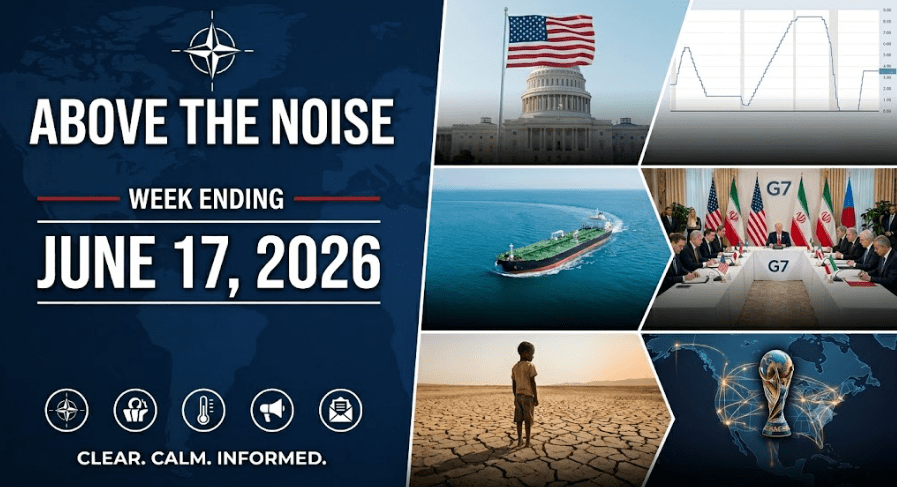
Top 5 Stories of the Week
Week Ending June 17, 2026
#1 U.S. and Iran Prepare to Sign Historic Peace Agreement
After months of escalating tensions and military conflict, the United States and Iran are preparing to sign a formal memorandum of understanding (MOU) that could mark the beginning of a broader peace process. The agreement is expected to be signed this week in Switzerland and includes commitments related to shipping security, sanctions negotiations, and nuclear oversight.
Why It Matters
A reduction in conflict lowers the risk of a wider regional war and helps stabilize global energy markets. Because oil prices affect everything from gasoline to grocery costs, developments in the Middle East often have a direct impact on American households.
The Bigger Picture
The agreement opens a 60-day window for further negotiations and could become one of the most significant diplomatic breakthroughs in the region in years.
#2 G7 Leaders Focus on Energy Prices and Global Stability
World leaders gathered at the G7 Summit this week to discuss economic uncertainty, energy security, and international stability. A major topic was the reopening of shipping routes through the Strait of Hormuz, a critical artery for global oil transportation.
Why It Matters
Lower energy prices help reduce inflation because transportation and manufacturing costs influence the price of many everyday goods and services.
The Bigger Picture
The decisions made by global leaders can affect everything from fuel prices to stock markets. International cooperation often plays a major role in preventing economic disruptions from becoming larger crises.
#3 CHIPS Act Drives Major Semiconductor Expansion in Texas
The Department of Commerce announced plans to support expansion of semiconductor manufacturing in Texas through the CHIPS Program. The funding is aimed at increasing domestic production of advanced photonic semiconductors that are essential for artificial intelligence, communications networks, and next-generation computing.
Why It Matters
Semiconductors power nearly every modern technology we use, from smartphones and vehicles to medical equipment and AI systems.
The Bigger Picture
By increasing domestic production, the United States hopes to strengthen supply chains, reduce dependence on foreign manufacturing, and remain competitive in the global technology race.
#4 UNICEF Warns of Growing Climate Risks for Children
A new UNICEF report found that billions of children around the world face increasing exposure to climate-related hazards such as droughts, heatwaves, floods, and extreme weather events. The report highlights the growing challenges many communities face as climate conditions continue to change.
Why It Matters
Climate-related disruptions affect food production, healthcare systems, infrastructure, and economic stability. Children are often among the most vulnerable populations during these events.
The Bigger Picture
The report shifts attention from environmental debates to practical questions about preparedness, resilience, and protecting future generations.
#5 Supreme Court Allows New York Gun Liability Law to Stand
As the Supreme Court approaches the end of its term, it declined to hear a challenge to a New York law that allows civil lawsuits against firearm manufacturers and wholesalers when marketing or sales practices are alleged to endanger public safety. Because the Court chose not to take the case, the law remains in effect.
Why It Matters
This decision could influence how states approach liability laws and public safety regulations. It may also encourage similar legislation and legal challenges in other parts of the country.
The Bigger Picture
The case illustrates an important aspect of the American legal system: when the Supreme Court declines to hear a case, lower court rulings remain in place. It also highlights the ongoing debate between state authority, business liability, and public safety concerns.
💡 What This Means For You
At first glance, this week’s stories may seem unrelated. One involves peace talks in the Middle East, another focuses on technology manufacturing, while others examine climate risks and Supreme Court decisions. However, they all share a common theme:
When conflict decreases overseas, energy prices often become more stable. When energy prices stabilize, transportation and manufacturing costs can fall. In turn, that can help ease inflation and reduce pressure on household budgets.
Meanwhile, investments in semiconductor manufacturing are aimed at strengthening America’s technology supply chain. The goal is to ensure that critical products—from smartphones to artificial intelligence systems—remain available and affordable in the years ahead.
The UNICEF climate report reminds us that today’s policy decisions can have long-term consequences for future generations. Preparing for climate-related challenges isn’t just about the environment; it’s also about food security, healthcare, infrastructure, and economic resilience.
Finally, the Supreme Court’s decision involving New York’s gun liability law highlights how state governments, federal courts, and private industries continually shape the laws that affect everyday life.
The decisions made by world leaders, lawmakers, courts, and government agencies today may not immediately affect your daily routine. However, over time they influence the prices you pay, the technologies you use, the laws you live under, and the opportunities available to future generations.
📚 Further Reading
Want to learn more about this week’s top stories? Explore these trusted sources for additional information and context.
🌍 U.S.–Iran Peace Agreement
The United States and Iran are preparing to sign a historic agreement aimed at reducing tensions, reopening trade routes, and preventing further conflict in the Middle East.
⛽ G7 Summit & Energy Prices
World leaders are focused on energy security, inflation, and economic stability as global oil markets react to recent geopolitical developments.
💻 CHIPS Act & U.S. Semiconductor Expansion
New federal investments are expanding domestic semiconductor production to support artificial intelligence, advanced manufacturing, and national security.
🌡️ UNICEF Climate Report
A new report warns that billions of children worldwide face increasing exposure to extreme weather, heatwaves, droughts, and other climate-related hazards.
⚖️ Supreme Court & New York Gun Liability Law
The Supreme Court declined to hear a challenge to a New York law that allows civil lawsuits against firearm manufacturers and wholesalers under certain circumstances.
🔗 Continue Learning
Interested in understanding the government systems behind these stories?