
The Chartreuse Reflection: Politics & Psychology
In 1837, Hans Christian Andersen wrote The Emperor’s New Clothes. This famous fairy tale describes a leader who marches through the streets naked. His subjects praise his magnificent new suit because they fear admitting what their own eyes see.
In June 2026, a modern variation of this tale played out at the Lincoln Memorial Reflecting Pool.
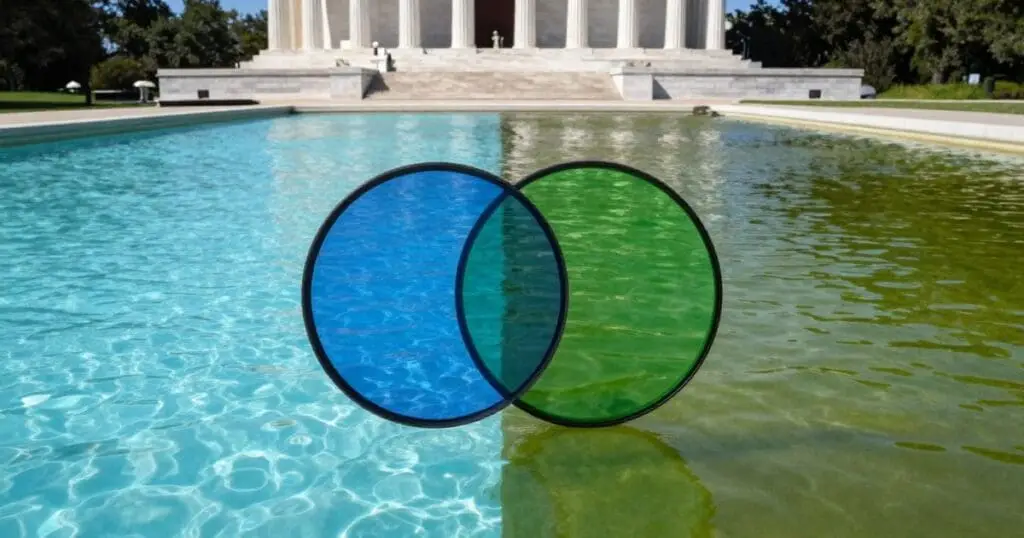
Following a controversial $14 million no-bid renovation, the historic landmark experienced a massive, vibrant green algae bloom. Yet, while independent photographs and tourists captured a chartreuse soup, President Trump posted on social media that the water was “beautiful” and “clean.” Shortly after, media broadcasts focused on tight, carefully cropped camera angles. They praised the pool’s “American Flag Blue” paint while bright green algae remained clearly visible right outside the frame.
How can two groups of people look at the exact same body of water and see two entirely different realities?
You don’t need a partisan lens to realize that something fascinating is happening to the human brain. What we are witnessing isn’t magic. Instead, it is a series of well-documented psychological survival mechanisms. Here is the science behind how modern political movements can effectively rewrite physical reality.
The The Psychology of Belief
1. Identity-Driven Perception (Identity Protection)
To an outside observer, looking at green algae and calling it “crystal clear” seems impossible. But cognitive psychologists know that human beings prioritize social belonging over objective facts.
When a person invests deeply in a political leader, that leader becomes a core part of their personal identity. If that leader makes a mistake, admitting the error creates intense psychological discomfort. Psychologists call this cognitive dissonance. In order, to protect their identity and stop that discomfort, the human brain literally alters its perception. It is mentally easier to believe the green water is just a temporary chemical reaction. This allows followers to credit a “cutting-edge technology” rather than admitting the leader oversaw a multi-million-dollar failure.
But cognitive psychologists have long known that human beings prioritize social belonging over objective facts. To explore this phenomenon further, readers can look at the landmark research on Identity-Protective Cognition via the Cultural Cognition Project led by Yale University scholars, which shows how individuals unconsciously dismiss physical evidence that threatens their group standing.
2. Selective Salience and Information Filtering
The media coverage surrounding the pool provides a masterclass in selective salience. This communication theory describes the practice of making one specific detail highly noticeable while completely ignoring the broader context.
Trusted media outlets frame a broadcast with deep blue graphics, crop the camera tightly on clean patches of water, and focus entirely on the intent of the project. By highlighting the goal of “restoring American heritage,” they provide a protective filter for their audience. The audience isn’t necessarily lying to themselves. Instead, a trusted source gives them explicit visual and narrative permission to categorize the visible green algae as “residual” or “fake news bias.”
Visit International Society of Political Pyschology to further explore published research that describes partisan information filtering, where trusted media outlets provide explicit visual permission to alter baseline perception.
3. The “Technobabble” Quick Fix Illusion
When physical evidence becomes too overwhelming to ignore, leadership often pivots to a new psychological tactic. They overcomplicate a simple failure with high-tech jargon to project absolute control.
When the public noticed the bloom, the administration did not admit to a design flaw. Instead, official statements highlighted “nanobubbler technology,” hydrogen peroxide oxidizers, and advanced chemical balance protocols. In environmental science, dumping massive amounts of peroxide into an overheating, dark-painted basin is merely an aggressive, temporary patch. But in political psychology, terms like “nanobubblers” act as a rhetorical shield. This language transforms a visible infrastructure failure into a high-tech victory. The followers don’t see a cover-up. They see a decisive leader deploying advanced science to defeat a temporary natural nuisance.
The Ultimate Danger: The Erosion of Shared Reality
The Lincoln Memorial Reflecting Pool will eventually clear. But the psychological precedent is much harder to clean up.
When a social media post can completely dismantle public consensus, the foundation of democratic accountability fractures. A leader can successfully declare a visible failure to be a flawless success while millions of citizens nod in agreement. When that happens, the rules of governing no-bid contracts, budgets, and taxes no longer matter.
The true danger isn’t that public money was mismanaged on a pool. The danger is that we are losing the ability to agree on what color the water is.
Before exploring how people interpret events differently, it is important to understand how procurement rules work in the first place.
Read our foundational report: Paint vs. Procurement: What the Reflecting Pool Algae Teaches Us About No-Bid Contracts.
Recommended Reading on Political Psychology
If you want to dive deeper into the science of how human brains process tribal information and alternative realities, consider checking out these foundational texts:
- “The Righteous Mind” by Jonathan Haidt: An indispensable book explaining why good people are divided by politics and religion, detailing how group loyalty alters our baseline moral reasoning.
- “Mistakes Were Made (But Not by Me)” by Carol Tavris and Elliot Aronson: The definitive guide on cognitive dissonance, showing exactly how the human brain self-justifies bad decisions to protect its ego.
- “Why We’re Polarized” by Ezra Klein: A structural breakdown of how modern media and political systems intentionally activate our identities to control the news cycle.